5 MYTHS ABOUT THE LNG TERMINAL REVEALING COMMON MISCONCEPTIONS IN SOCIETY
2018-11-15
Company news
Benefits brought by the liquefied natural gas (LNG) terminal, which in four years managed to save Lithuanian population's incomes by EUR 103 million due to lower gas prices, were already noticed by many residents of the country, especially when gas prices in Lithuania are among the lowest in Europe at the moment. Smaller terminal would make the gas more expensive because its servicing would be more complicated. That is the truth; however a myth that the present terminal is too big is spreading in public space. And there is more than one myth – about terminal maintenance, transfer into private hands, impact on decrease of gas prices. So, what are the true facts?
1st myth: LNG terminal is too big for Lithuania
The capacity of the LNG terminal is 170 thousand m3. Now, gas carriers of global standard of capacity of 130 – 150 thousand m3 gas bring gas to it. If it was decided to replace the storage vessel with a smaller terminal, e.g. of 50 thousand m3 storage capacity, several problems would arise, which are discussed in the information video from the series called #energyfreedom (Lithuanian language): https://www.youtube.com/watch?v=_-rDBhRAw50
'Smaller terminal would not be able to accept big gas carriers of global standard. Therefore, small gas carriers would have to bring gas, but it means a bigger number of carriers resulting in a rise of reloading cost. It would inevitably increase gas price. Besides, a smaller terminal would not manage to cope with a crisis in winter season – with increased demand for gas, such terminal would not be able to secure necessary quantity of gas', explained Mindaugas Jusius, CEO of KN.

Residents have to contribute to the LNG terminal maintenance – security component is included into gas price. Nevertheless, having calculated the decrease of gas price after launching the terminal, it is evident that residents pay less because of the terminal.
Price of 1 cubic meter for domestics consumers using gas for cooking in the period from the 1st half of 2014, when the terminal was not in operation yet, until now dropped down by 18 Eurocents. Security component in gas price amounts to 3 Eurocents. Thus, residents save six times more than pay for security.
Gas price for residents using gas for cooking and heating decreased by 15 Eurocents during the same period mentioned above. The security component in gas price for them amounts to 5 Eurocents, thus they save 3 times more than pay for security.
Following drop in prices of gas import into Lithuania, big gas consumers also enjoy benefits – the average price of gas import into Lithuania decreased by 31 per cent in the period of four years. This way, organisations are able to make flexible decisions whether to buy gas through the terminal or pipeline from Gazprom.
3rd myth: natural gas may not be needed in the future
International Energy Agency forecasts growth of gas import into Europe in the nearest two decades rather than decrease. If comparing year 2016 (305 billion m3 imported gas) with 2040 (395 billion m3), it should increase by 23 per cent.
Gas will be needed in our country as well, besides, Lithuania can make money from it in foreign markets. 'At present, Lithuania mainly imports electricity, but in the future, with electricity demand further increasing, it will have to be generated in Lithuania, as well. And the most cost-effective scenario will be generation from gas. The role of gas, facing rise in biofuel prices, can increase also in heating sector. Sea and road transport is increasingly shifting towards liquefied natural gas. Furthermore, when the link with Poland will be launched, Lithuania could export gas to Central Europe', said Mr. Jusius.
4th myth: the terminal should be in private hands
Should the terminal be transferred into private hands and lose state guarantees, the dominating supplier could dump gas prices for a year or two , i.e. could cut them down so much that buying gas from him only would be cost-effective. According to Mr. Jusius, in such event the LNG terminal would turn into an unnecessary burden to the owner of the terminal.
'The terminal would most probably go bankrupt or would be cheaply sold by the owner. The, the dominating supplier could increase prices. According to the calculations of Pöyry Management Consulting, the price of imported gas could increase by 11–20 per cent if the terminal was rejected. While Lithuania would no longer have an alternative and would be forced to buy gas from the dominating supplier for his asking price', explained CEO of KN.
5th myth: gas price in Lithuania dropped down because of its global drop in 2014
If drop in gas price in Lithuania was determined merely by global tendencies, the change in prices had to be similar everywhere, but that is not the case.
The average gas price on the British NBP exchange decreased by 15 per cent in the period of four years – from 24.07 EUR/MWh (1st half of 2014) down to 20.49 EUR/MWh (1st half of 2018).
While the average price of gas import into Lithuania dropped down twice more than on the NBP exchange – by as many as 31 per cent: from 29.84 EUR/MWh (1st half of 2014) down to 20.60 EUR/MWh (1st half of 2018).
'The fact that the gas prices in Lithuania decreased two times more than in Western Europe proves that it is not the consequence of global price drop only. It is the result of the operation of the LNG terminal as well', said Mr. Jusius, CEO of KN.
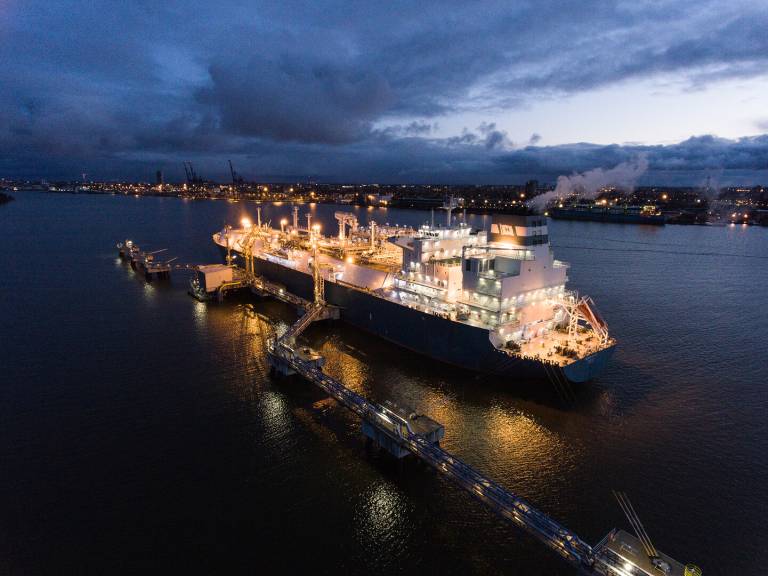
On Monday, a liquefied natural gas (LNG) cargo from the United Stats of America ordered by D.TRADING International SA, a subsidiary of DTEK Group, the largest private Ukrainian energy company, reached the Klaipėda LNG terminal operated by the international terminal operator KN Energies. Approximately 160 thousand cubic metres of U.S....
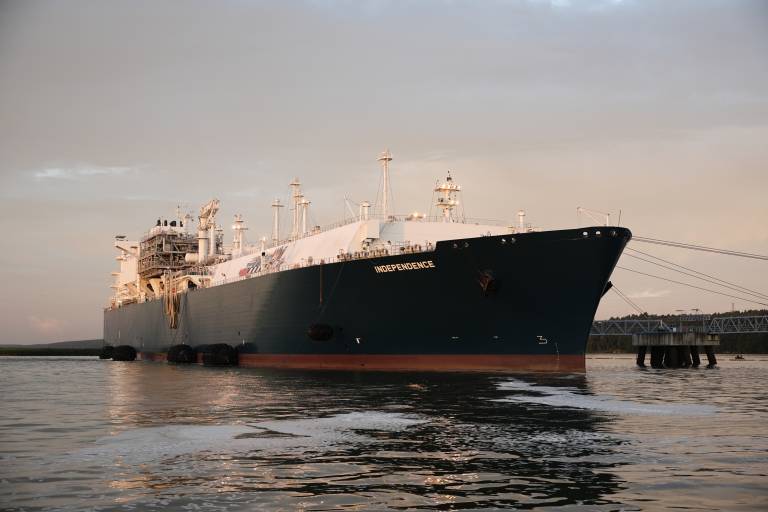
Exactly 11 years ago, on 27 October 2014, the liquefied natural gas (LNG) floating storage and regasification unit (FSRU) Independence reached the Port of Klaipėda. Lithuania’s liberation from the grip of a monopolist became not only an inspiration for the Baltic region but also ensured energy security and the right for consumers...
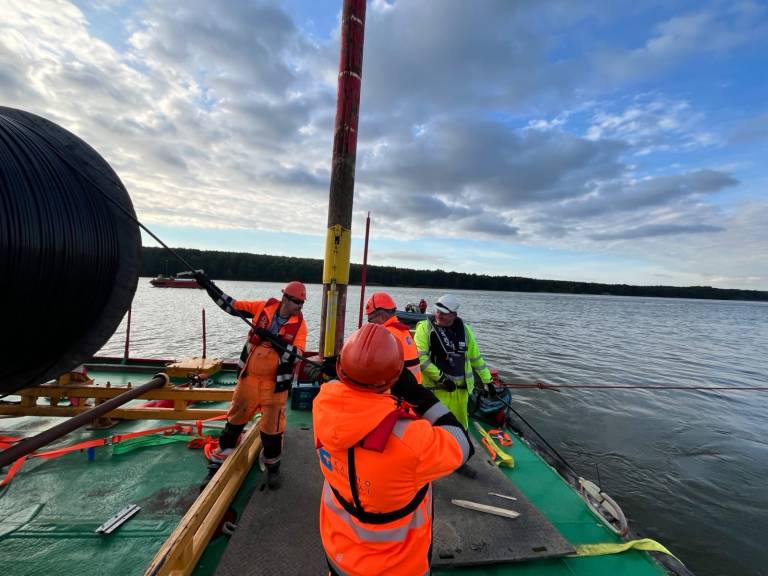
As part of the shore electricity connection project to the Klaipėda LNG terminal implemented by the international energy terminal operator KN Energies, the first works have begun. The company executing the project, Kauno tiltai, has started cleaning a pipe installed using the horizontal directional drilling (HDD) method and carrying out...