Caring for the environment — building a responsible tomorrow

A company ensures the maximum security of managed terminals and implements the highest standard solutions. In its activities the company uses modern production techniques and constantly implements technical measures to reduce waste emissions, as well as carries out adequate and regular maintenance and surveillance.

2023

>30% CO₂ reduction compared to 2023

2040

~70% CO₂ reduction compared to 2040

2050

climate neutrality

Water

All the waste water generated and collected by the company, as well as bilge water from ships is being thoroughly cleaned. The water is released to the Klaipeda port channel only after laboratory control is conducted. The Curonian Lagoon water is sensitive to pollutants, and KN cleans collected water from pollutants to the required standards. Purified water discharged by KN is often much cleaner than the water of the Curonian Lagoon.

Air pollution

The company, in accordance with the regulations of Environmental monitoring of an Economic Entity, according to the Company’s monitoring program coordinated with the environmental protection authorities, carries out the monitoring of air pollution emissions from stationary air pollution sources and the monitoring of an impact on the environmental air quality.

Water treatment process

The company has installed biosorptive water treatment system. This is a unique technology, designed by the company for the treatment of collected water. The biological water treatment system cleans wastewater to the required purity, and this process includes several stages: wastewater is treated with activated carbon and microorganisms.

The monitoring process

In accordance with the monitoring plan of an impact on the environmental air quality, once a month the Company carries out the measurements of volatile organic compounds (VOC) in ambient air in 4 spots outside the Company’s territory.

The Company continuously carries out the monitoring of the impact on ambient air quality. Monitoring data obtained during the process are provided for the competitive environmental protection authorities.

Equipment and measures

Biosorber is a container of 400 m3 filled with activated carbon, biologically active sludge, highly dispersive diffusers and air distribution system, wastewater feed and treated water draining system, as well as biosorber washing system. Benefit:

  1. Purified water is often much cleaner than the water of the Curonian Lagoon.
  2. Waste water treatment system is unique.
  3. Technological equipment occupies small area.

Equipment and measures

The Company carries out the handling works related to oil products in accordance with the Integrated Pollution Prevention and Control permit issued by the Environmental Protection Agency, which specifies that the Company, while carrying out loading of oil products, is required to implement (and implements) these environmental measures to reduce emission of pollutants and odors into the environment:

  • VOC recovery unit is used while unloading gasoline from railway wagons into the ground tanks;
  • while unloading petroleum products (fuel oil, diesel oil, etc.) from railway wagons, the wagons are affixed with special covers with valves that prevent emission of VOC from wagons to the environment;
  • loading gasoline to the petrol tankers and loading fuel oil, diesel oil into the petrol tankers, that were previously used for the transportation of oil, VOC vapors produced during the loading process are burned in the VOC vapor incineration equipment – torch.

All of these technological devices retain more than 98% of released fumes.

400000

This much wastewater is treated each year by KN’s advanced purification technologies.

98 %

Modern equipment captures this share of vapours that would otherwise be released into the environment.

5 mg/m³

Not once has the legally established half-hour VOC limit value been exceeded in ambient air.

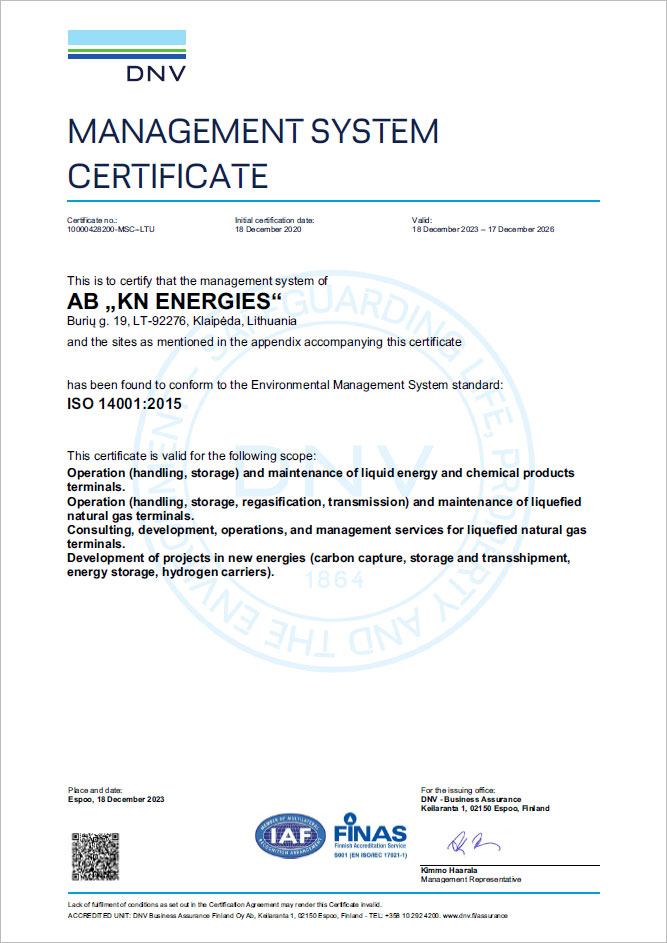
ISO 14001:2015

The KN Environmental Management System complies with the ISO 14001: 2015 standard. A company ensures the maximum security of managed terminals and implements the highest standard solutions. In its activities the company uses modern production techniques and constantly implements technical measures to reduce waste emissions, as well as carries out adequate and regular maintenance and surveillance.

Let us know if you have any questions

The well-being of residents is very important to us, and we are always ready to provide up-to-date information about handling processes and to respond promptly to any complaints regarding odours. You can call the company at any time of day.

Contact us by phone Contact us by phone

Environmental plan

No.Air pollution reduction measuresExpected resultsImplementation deadline*Progress
1 Installation of an air-pollution control unit designed to treat emissions collected from:
(i) 16 existing oil-product storage tanks located in the dark oil products (DOP) park;
(ii) railway loading racks No. 1–2 used for loading dark oil products (e.g., fuel oil).
Reduction of volatile organic compound (VOC) emissions released during the loading of oil products to/from rail tank cars and during loading and storage in tanks.2022-12-31  
  
Project completed 100%.
Early Q2 2021 – air-pollution control unit installed. 16 tanks connected to the system.
Q4 2022 – railway loading racks No. 1–2 connected to the system.
The purpose of this unit is to reduce odour intensity generated during the loading of fuel oil or crude oil.
2 Modernisation of the 2×45 MW boiler burners at the Klaipėda terminal boiler houseAfter burner upgrades, one-off nitrogen oxide and carbon monoxide emissions will be reduced from 300 mg/m³ to 100 mg/m³.2021-12-31 
  
Project completed 100%.
Q2 2021 – new burner installed in Boiler No. 1.
Q4 2021 – new burner installed in Boiler No. 2.
Environmental targets — reducing NOx and CO concentrations threefold — achieved.
3 Collection of air pollutants from 12 tanks (currently 10 tanks constructed) storing light products (e.g., gasoline) and their connection to the existing air-pollution control system — VOC incineration unit.Tanks will be connected to the VOC incineration system, ensuring minimal emissions into the environment. 2025-12-31 2025 Q1–Q4 — design, procurement and installation of additional equipment required to direct emissions to the VOC incineration unit are underway.    


* The Company is subject to public procurement procedures, which may affect the planned implementation date of the measure. Commissioning and adjustment works for the installed environmental infrastructure may take 6–8 months from the installation date.

** The project was partially financed from the Lithuanian Environmental Investment Fund (LAIF) programme.

Environmental monitoring at the terminals

We monitor environmental conditions at three levels — national, municipal and company level — to ensure comprehensive control of air quality, water quality and environmental impact.

Near the Klaipėda liquid energy terminal, there are two national environmental air-quality monitoring points, where volatile organic compounds (VOCs) in ambient air are measured. This monitoring is carried out at a set frequency.

Updated on 5 November 2025.

View View

Monitoring is continuously observed and evaluated

  • Environmental monitoring (sample collection and laboratory analysis) is carried out by authorised institutions holding the required permits.
  • The monitoring data show that pollutant concentrations in ambient air and in the Curonian Lagoon do not exceed the established limit values.
  • Annual environmental monitoring results and their analysis are submitted to the authority responsible for environmental protection.

Ambient air real-time monitoring

To monitor and manage the potential environmental impact of the Klaipėda liquid energy terminal (LET), KN Energies has installed sensors around the perimeter of the terminal for self-monitoring purposes. These sensors continuously measure concentrations of volatile organic compounds (VOCs) in ambient air.

According to legal requirements, the half-hour VOC limit value is 200 mg/m³ in the workplace environment (within the Klaipėda LET territory) and 5 mg/m³ in residential areas (outside the KN territory).

Although the sensors are installed within the LET territory, all measured VOC values are compared against the residential-area limit of 5 mg/m³. Sensor data are updated every 30 minutes.

In the ambient air monitoring scheme, several VOC sensors are highlighted in coral colour, indicating that their readings may reflect the impact of another oil and chemical product handling terminal operating near the LET.

Monitoring data from previous periods

News and insights

Contact us

Want to learn more about how we reduce our operational footprint?

This site is registered on wpml.org as a development site. Switch to a production site key to remove this banner.